
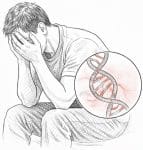
The genetic architecture of major depressive disorder is one of the most extensively studied and most intensively debated topics in psychiatric genetics, reflecting both the clinical importance of understanding the hereditary contributions to a condition affecting hundreds of millions of people worldwide and the extraordinary scientific challenges involved in dissecting the genetic basis of a phenotypically complex, etiologically heterogeneous, and clinically variable disorder. The evidence that genetic factors contribute meaningfully to depression risk is compelling and comes from multiple complementary research designs, including family studies demonstrating the familial aggregation of depression, twin studies that partition familial resemblance into genetic and environmental components, adoption studies that separate genetic from rearing environment effects, and increasingly, molecular genetic studies that identify specific genetic variants associated with depression risk at the level of the DNA sequence. Understanding what the current genetic evidence actually tells us about depression, and what it does not, is essential for translating genetic research into clinical and public health benefit.
The clinical relevance of understanding genetic predisposition to depression extends in multiple directions simultaneously. For individuals with a family history of depression, understanding the genetic contribution to their risk provides a framework for interpreting their own vulnerability and for making informed decisions about preventive interventions, early monitoring, and treatment-seeking when symptoms emerge. For clinicians, the growing evidence that genetic variants influence not only depression risk but also treatment response to specific antidepressants is beginning to offer practical guidance for medication selection, a development that promises to reduce the trial-and-error approach to antidepressant prescribing that characterizes current clinical practice. For researchers, the identification of specific genetic variants and biological pathways implicated in depression risk provides validated targets for drug development and biological investigation that can accelerate the discovery of novel treatments.
The familial aggregation of major depression is one of the most consistently documented findings in psychiatric epidemiology. First-degree relatives of individuals with major depressive disorder have a two to three fold elevated risk of developing depression themselves compared to the general population, a degree of familial clustering that represents a clinically and statistically significant departure from the background population risk. This familial clustering reflects the combined contributions of shared genetic factors, shared family environments, and the complex interplay between genetic vulnerability and environmental exposure that operates within families. The challenge of separating these contributions, which cannot be accomplished through family study designs alone, has driven the extensive use of twin and adoption study methodologies in psychiatric genetics research.
Twin Studies and Heritability Estimates
Twin studies, which exploit the natural experiment of comparing the concordance rates for depression between identical twins who share essentially all of their genetic material and fraternal twins who share on average fifty percent of their segregating genetic variants, have been the primary tool for estimating the heritability of major depressive disorder over the past four decades. The heritability of a trait, as estimated from twin studies, represents the proportion of phenotypic variance in a population that is attributable to genetic differences between individuals, and provides the most direct quantification of the importance of genetic factors in determining individual differences in depression risk.
Meta-analyses of twin studies of major depressive disorder yield heritability estimates in the range of thirty-five to fifty percent, with some individual studies reporting estimates outside this range depending on the specific diagnostic criteria applied, the method of depression assessment, the sex composition of the sample, and the statistical model used to partition genetic and environmental variance components. These heritability estimates indicate that genetic factors account for approximately one third to one half of the variance in depression risk in the populations studied, confirming a meaningful genetic contribution while simultaneously establishing that environmental factors account for a substantial and roughly equal or greater proportion of the remaining variance. This heritability estimate for depression is lower than that reported for schizophrenia and bipolar disorder but falls within a range that clearly supports the existence of genetic risk factors with meaningful clinical and biological relevance.
An important and counterintuitive finding from twin studies of depression is that the shared family environment, which represents the environmental experiences common to both members of a twin pair by virtue of growing up in the same household, contributes relatively little to the familial clustering of depression. The familial resemblance for depression is almost entirely attributable to genetic factors rather than to the sharing of parental rearing style, socioeconomic status, neighborhood, school environment, or other family-level environmental factors that both twins experience in common. This finding does not mean that environmental experiences are unimportant in depression, as individual-specific environmental experiences that differ between members of a twin pair account for a large proportion of depression variance, but it indicates that the particular family-level environmental factors that make siblings similar to each other contribute little to the familial aggregation of depression.
Molecular Genetic Architecture
The molecular genetic investigation of depression has progressed through multiple technological generations, from candidate gene studies testing specific hypotheses about individual genes known to be involved in monoamine neurotransmission or stress response, through genome-wide association studies that survey the entire genome for associations between common genetic variants and depression without requiring prior biological hypotheses, to the sequencing-based approaches that examine the contribution of rare genetic variants of larger individual effect. This progression has produced an increasingly comprehensive picture of the genetic architecture of depression while simultaneously revealing that the genetic basis of the disorder is substantially more complex than early candidate gene studies anticipated.
Candidate gene studies of depression focused primarily on genes encoding components of the serotonergic, noradrenergic, and dopaminergic systems that are the targets of effective antidepressant medications, as well as on genes regulating the hypothalamic-pituitary-adrenal stress axis whose hyperactivation characterizes many depressive presentations. The serotonin transporter linked polymorphic region, a functional variant in the promoter region of the SLC6A4 serotonin transporter gene that influences its transcriptional efficiency, attracted particular attention following the publication of a landmark 2003 paper by Caspi and colleagues reporting that the short allele of this polymorphism moderated the relationship between stressful life events and depression, with short allele carriers showing greater depression susceptibility following stress exposure than long allele carriers. However, subsequent large-scale meta-analyses combining data from multiple cohort studies failed to replicate this gene by environment interaction, illustrating the tendency of early candidate gene findings to overestimate effect sizes due to small sample sizes and publication bias.
Genome-wide association studies of major depressive disorder have required sample sizes in the hundreds of thousands of participants to achieve sufficient statistical power to reliably detect the very small individual effects of common genetic variants on depression risk, reflecting the highly polygenic architecture of the disorder in which thousands of variants each contribute negligibly small increments of risk but whose aggregate effect is substantial. The Psychiatric Genomics Consortium analysis of more than 300,000 cases and controls identified more than 100 independent genetic loci associated with major depression at genome-wide significance, with each individual locus explaining a tiny fraction of depression heritability but the collective pattern of implicated loci revealing biological insights into the pathways and processes contributing to depression risk. The genes in these associated loci are enriched for those involved in synaptic biology, neuronal development, transcriptional regulation in neurons, and the regulation of the hypothalamic-pituitary-adrenal axis, providing genetic validation for the neurobiological hypotheses generated by decades of pharmacological and neuroimaging research.
Gene by Environment Interactions
One of the most clinically and scientifically important insights from genetic research on depression is the recognition that genetic risk factors for depression typically exert their effects not in a deterministic, all-or-nothing fashion but through interactions with environmental experiences, particularly stressful and traumatic life events, that either activate or suppress the expression of genetic vulnerability. This gene by environment interaction framework, in which the same genetic variant confers differential depression risk depending on the environmental context in which it is expressed, helps explain why individuals with equivalent genetic risk loads have very different depression outcomes depending on their life experiences and why the same stressful experience produces depression in some individuals but not others with apparently similar psychological profiles.
The biological mechanisms through which genetic variants interact with environmental exposures to produce depression risk include epigenetic regulation of gene expression, in which environmental exposures such as early childhood adversity alter the methylation of cytosine residues in the promoter regions of stress-response and neuroplasticity genes, producing lasting changes in transcriptional activity that persist long after the initial environmental exposure has ended. These epigenetic changes, which represent a molecular memory of adverse environmental experience encoded in the chromatin structure of neurons, may be transmitted across cell divisions during neuronal development, producing stable alterations in the expression of genes governing corticotropin-releasing hormone, glucocorticoid receptor, and brain-derived neurotrophic factor that program the hypothalamic-pituitary-adrenal axis and other neurobiological systems toward a stress-sensitized state that increases subsequent depression vulnerability.
Polygenic risk scores for depression, derived from genome-wide association study findings by aggregating the weighted contributions of thousands of individual genetic variants into a single summary measure of genetic liability, have demonstrated that higher genetic liability for depression predicts not only the probability of developing a depressive episode over the lifetime but also the trajectory of depressive symptoms across development, the severity and recurrence of depressive episodes, and the likelihood of treatment response to specific antidepressant medication classes. The clinical translation of polygenic risk scores into actionable tools for depression prevention and personalized treatment selection is an active area of research and represents one of the most promising near-term applications of genetic knowledge to clinical depression management, though the predictive precision of current polygenic risk scores remains insufficient for clinical decision-making in individual patients without integration with clinical and environmental risk factors.
Clinical Implications of Genetic Research
The clinical implications of the genetic research on depression span prevention, diagnosis, and treatment in ways that are beginning to influence clinical practice and that will almost certainly become more prominent as genetic knowledge advances and as the cost and accessibility of genomic testing continues to improve. The identification of individuals at elevated genetic risk for depression through polygenic risk scoring or through the identification of high-penetrance single-gene variants provides a potential basis for targeted preventive intervention, in which individuals with elevated genetic liability are offered enhanced monitoring, early access to psychological prevention programs such as mindfulness-based cognitive therapy or cognitive behavioral therapy based prevention programs, and education about the environmental risk factors whose modification could reduce the probability that genetic predisposition is converted into clinical depression.
Pharmacogenomic testing for variants in genes encoding cytochrome P450 drug-metabolizing enzymes, particularly CYP2D6 and CYP2C19, which metabolize the majority of commonly prescribed antidepressants, has moved from research tool to clinical application in some health systems, providing guidance for antidepressant dose selection and for identifying patients at elevated risk of drug toxicity or treatment failure due to atypical drug metabolism. Patients who are CYP2D6 poor metabolizers will achieve higher plasma concentrations of many antidepressants at standard doses, increasing the risk of dose-dependent adverse effects, while ultra-rapid metabolizers will achieve sub-therapeutic concentrations that explain their apparent lack of treatment response. The systematic incorporation of pharmacogenomic testing into antidepressant prescribing decisions has demonstrated reduced time to effective treatment and reduced adverse effect burden in clinical trials, representing a practical near-term application of genetic knowledge to depression treatment optimization that is increasingly accessible in clinical settings.